
Cryogenics
What is a vaporizer?
The vaporizer allows you to switch from a liquid phase to a vapor phase. It’s :
- A pressure vessel. As such, it must comply with the PED 2014/68/EU (European Pressure Equipment Directive),
- Subject to high temperature constraints. The temperature of the gas flowing through it will generally change between ~-180°C and ~+20°C,
- Subject to high mechanical stresses, because as the gas heats up, it expands and increases its flow velocity, thus its kinetic energy inside the vaporizer,
- High calorie consumer in order to “overcome” the enthalpy of gases.
What we do at CEPHI?
CEPHI’s design office specializes in pressure vessels. He has more than 40 years of experience in this field and has mastered various design codes (RCC-M, CODAP, EN 13445, CODETI, EN 13480, ASME, AD-MERKBLATT…). It is equipped with calculation tools for mechanical sizing.
Through the acquisition of its know-how license, CEPHI benefits from many years of experience and thus from the operating feedback from a large number of gas vaporization installations. It has a design tool that allows it to correctly size each vaporizer and to guarantee its proper functioning.
Many sectors of activity (agri-food, water treatment, steelmakers, glassmaking, petrochemicals…) need to vaporize gases.
Depending on the applications we have to manage :
- a different gas among the air gases (N2, O2, Ar, CO2, Ne, He, Kr, H2, Xe and Rn),
- a specific operating pressure,
- a particular flow rate according to the expressed need,
- a different gas outlet temperature from the inlet temperature,
- a greater or lesser acceptance of the pressure delta between the inlet and outlet of the vaporizer commonly called DP,
- congestion constraints,
- different calorie providers (air, groundwater, process water, hot water, steam, electric immersion heater and heating gas).
The air that constitutes the Earth’s atmosphere is a gas mixture, transparent, odorless, tasteless, of relatively constant concentration: only the concentrations of water and carbon dioxide can vary.
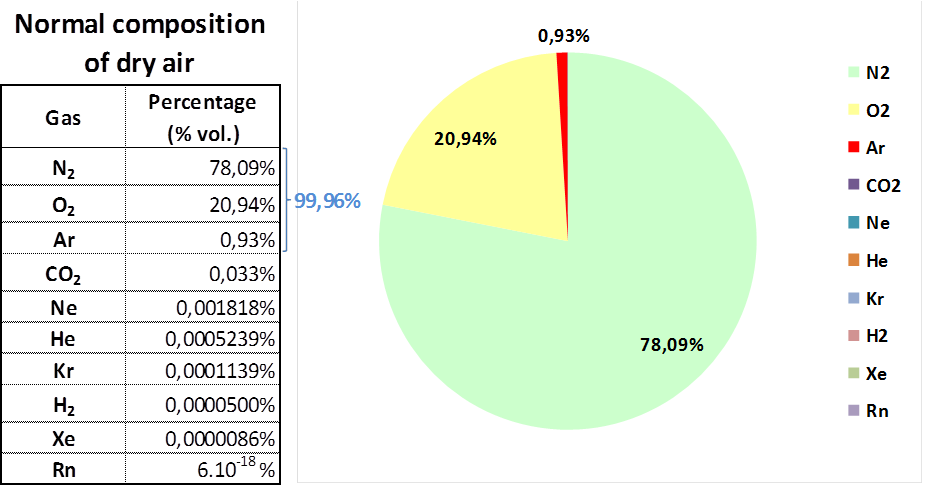
The gases opposite are extracted from the air. As the density is very low in the gas phase and at atmospheric pressure, they are stored at high pressures (generally 20 or 30 bar) and at very cold temperatures <-180 ° C.
Compressing and cooling the gas reduces its volume in ratios between 700 and 900 times relative to atmospheric pressure and ambient temperature to 20 ° C.
Subsequently, to be used, the gas stored in the liquid phase must be converted back into the gas phase.
The multiplicity of these parameters explains why all our customers have different and specific needs and why, depending on their needs, we direct them to different types of vaporizers with them :
- atmospheric vaporizer,
- pool tank vaporizer with or without pressure drop,
- electric vaporization…
Working with CEPHI allows you to know all the spray options available according to your needs.
The different types of vaporizers
Whatever your requirements, CEPHI has the right solution for your needs, as evidenced by our many achievements in pool tank sprays for Air Liquide, Messer, Westfalen and Lindé as well as our pipework for Praxair, Air Products, etc. Depending on your needs, you will use a pool or atmospheric tank vaporizer.
| Pool tank type Tablecloth-Diaphragm | Atmospheric vaporizer | |
|---|---|---|
| Price | More | Weaker |
| Loss of Charge | Weak | Great |
| Debit | Instantaneous and constant | Non instantaneous and decreasing |
| Operation | Continuous 24 hours | Not continuous and dependent on weather conditions |
Vaporizers with tank
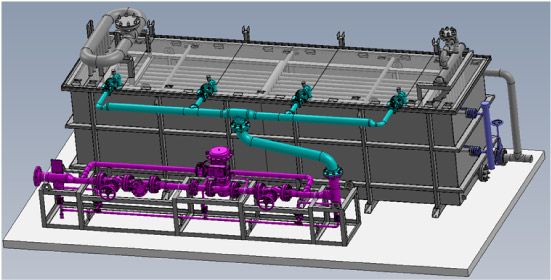
These vaporizers consist of a tubular bundle in which the gas flows. The beam is immersed in a tank containing water. The gas in the liquid phase at the beginning, will draw calories on the walls of the tube as it progresses inside the beam. The beam cooled by the calories taken by the gas will cool in turn and draw calories in the fluid that surrounds it.
If we do not bring calories to the fluid contained in the tank and surrounds the beam then this fluid will cool until going into solid phase (ice). This is a stopping point for the proper operation of the vaporizer.
To bring calories we can use:
- steam so as to regulate the temperature of the tank,
- hot water from a boiler running on fuel or gas,
- one or more electric resistances that will heat the water,
- city gas that through an autonomous system (T.I.C.) will regulate the temperature of the water tank,
- process water when the end user has it,
- groundwater.
Each of these possibilities has its advantages and disadvantages, as shown in the table below:
Advantages and disadvantages of the different calorific inputs of vaporizers
| Advantages | Disadvantages | Comments | |
|---|---|---|---|
| Steam | Flexible operaion | Requires a steam injection line | Generally for high-capacity vaporizers |
| Hot water | Optimized Energy Solution | Requires a boiler | A hot water flow adapted to the needs of the beam |
| Electricity | Simplicity of installation and small footprint | Exploitation cost | Generally reduced to powers ≤ 200 kW |
| Town Gas | Compactness and flexibility | Not suitable for O2 vaporizers | Simple to implement |
| Process water | Low operating cost | Requires a larger area of exchange | Generally requires large flow |
| Earth water | Low operating cost | More surface area than hot water | Generally requires large flow |
Description of the beam
It is a pressure vessel that contains:
- gas in the liquid phase,
- on a certain portion of the two-phase gas beam, that is, a gas mixture in liquid and gaseous phase,
- gas phase gas.
We offer all kinds of beams. The parameters that intervene and which guide the choice of design are:
- the permissible pressure loss by the customer, namely, the pressure difference between the outlet of the vaporizer and the inlet thereof,
- the linearity and the reactivity in the vaporization, in other words, the dynamism of the vaporizer,
- the non acceptance of water hammer on start-up.
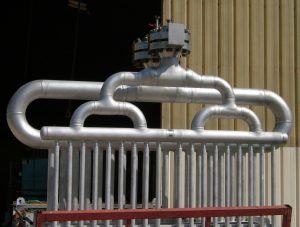
In the case where the permissible loss of load is important, we can propose a serpentine or pin tubular bundle.
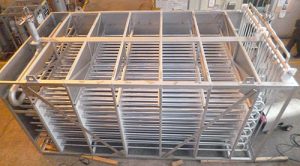
On the other hand, if the customer wants to have high performances with an instantaneous and linear flow, minimal pressure losses and overcome the water hammers, another equipment is necessary: The nappe diaphragm® CEPHI.
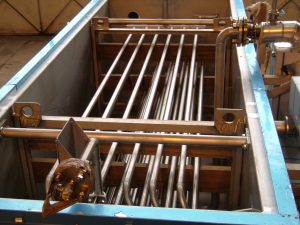
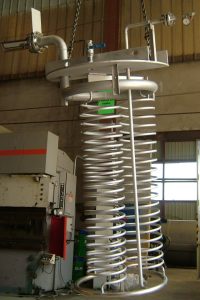
The Nappe Diaphragm® CEPHI
Outstanding performance for the most critical applications
Considerable advantages over conventional systems:
- The nappe diaphragm® minimizes pressure losses with a DP <300 mbar,
- The nappe diaphragm® guarantees instant, consistent and constant flow,
- The nappe diaphragm® eliminates water hammers thanks to its exclusive design. It therefore ensures exceptional longevity of the equipment,
- The nappe diaphragm® is suitable for ALL flow rates.
ICT warming
Combining high performance, respect for the environment and safety
This system, associated with the nappe diaphragm® bundle,
offers major economic, technical and environmental benefits:
- Strong performance of the ICT system,
- Very limited floor space,
- Device autonomy,
- Precise maintenance of the water temperature of the tank to within a few °C of the set temperature,
- Nominal flow rate of instant flash fluid Elimination of the risks of liquid gas plugs and pulsations,
- Reduction of losses: the flue gas outlet temperature is 110 °C instead of 140 to 180 °C with a conventional boiler,
- Respect for European environmental standards,
- No risk of pollution of the bath water: the combustion product of the gas burner circulates independently in the TIC immersion heat exchanger and is not in direct contact with the bath water.
-
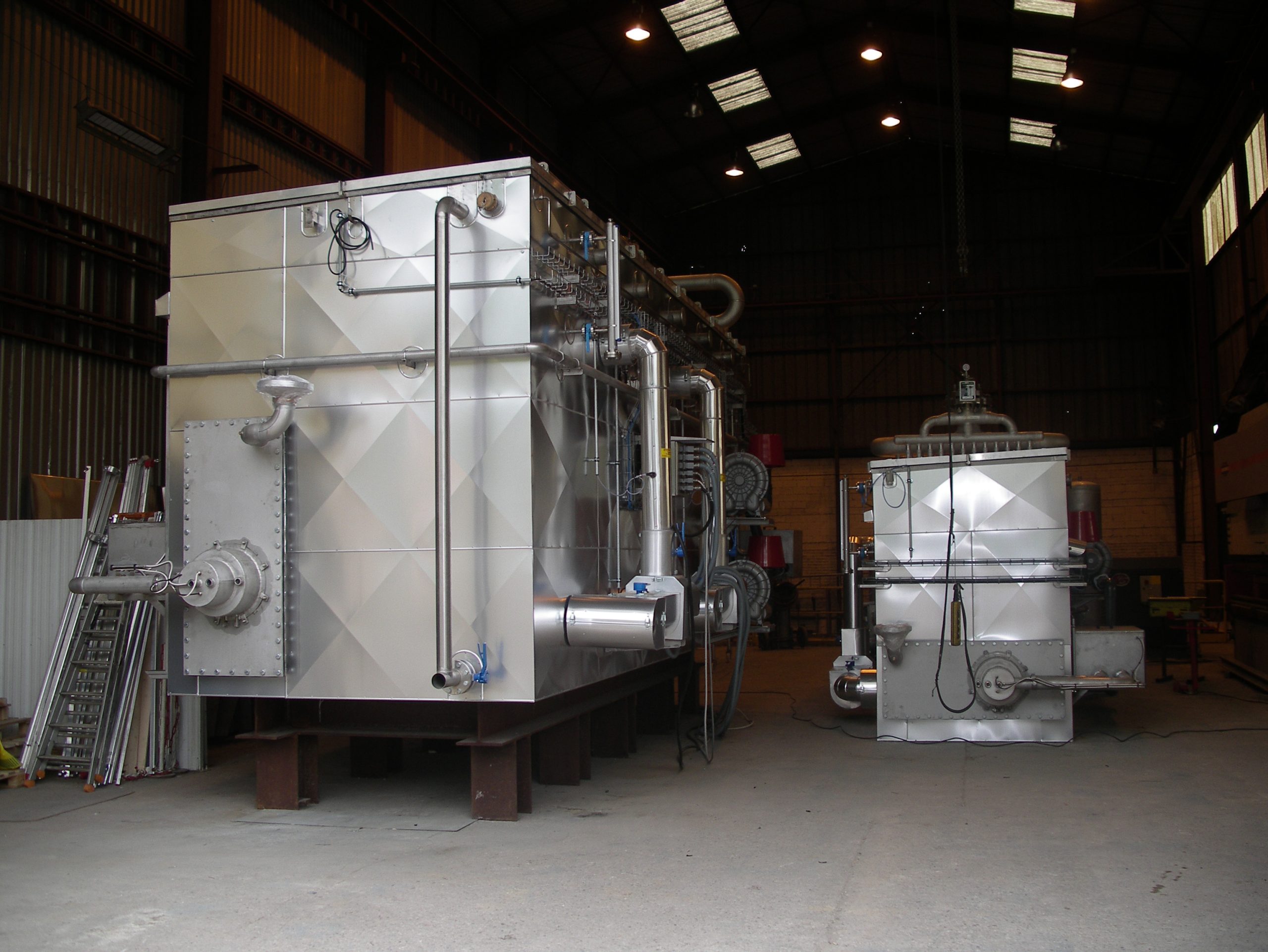
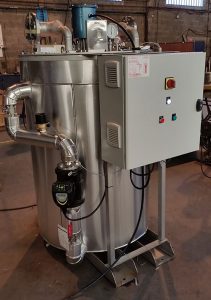
- Nitrogen vaporizers ITC 32 000 Nm³/h 80 bar
-
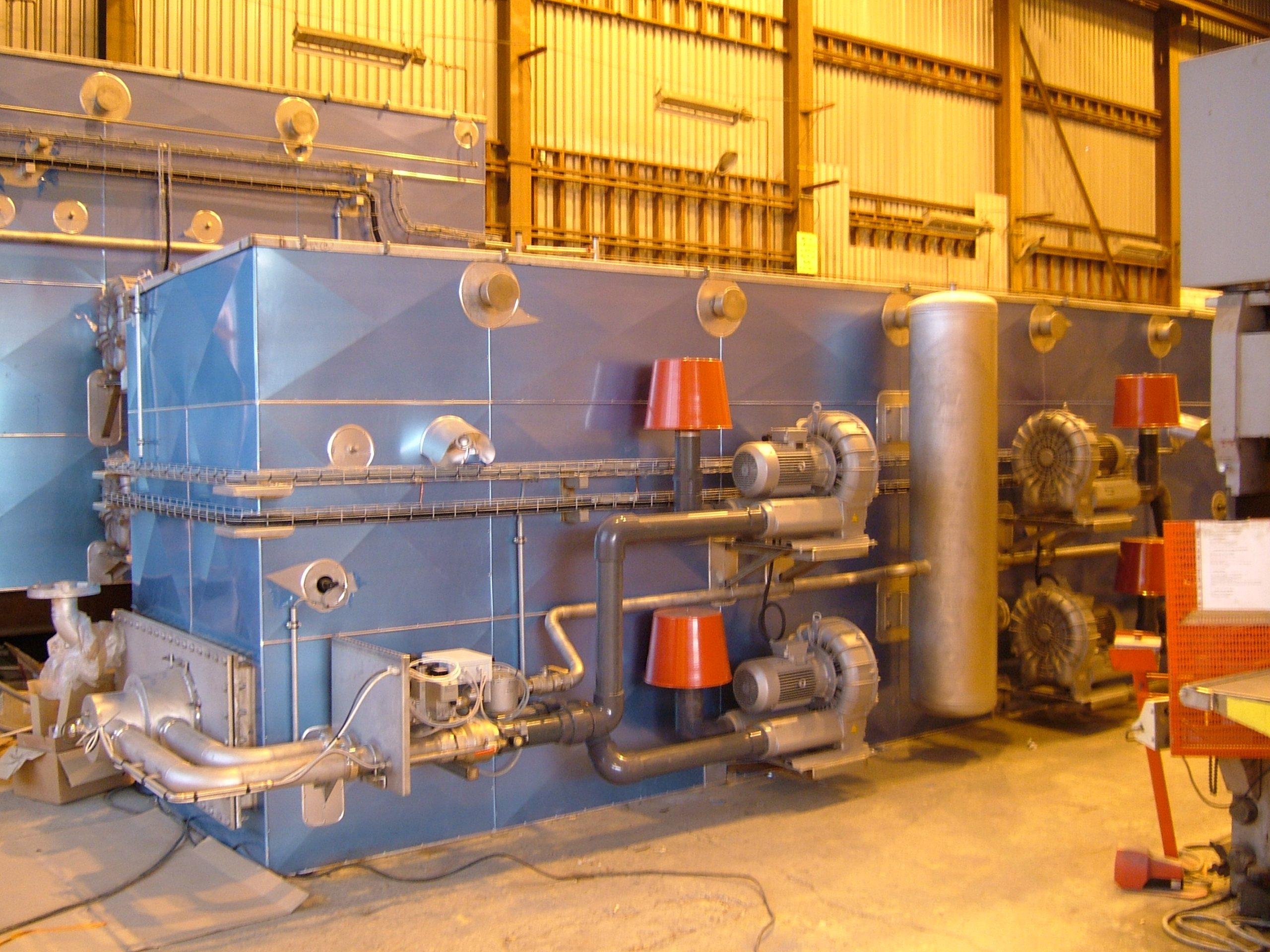
- Nitrogen vaporizers ITC 16 000 Nm³/h 40 bar
-
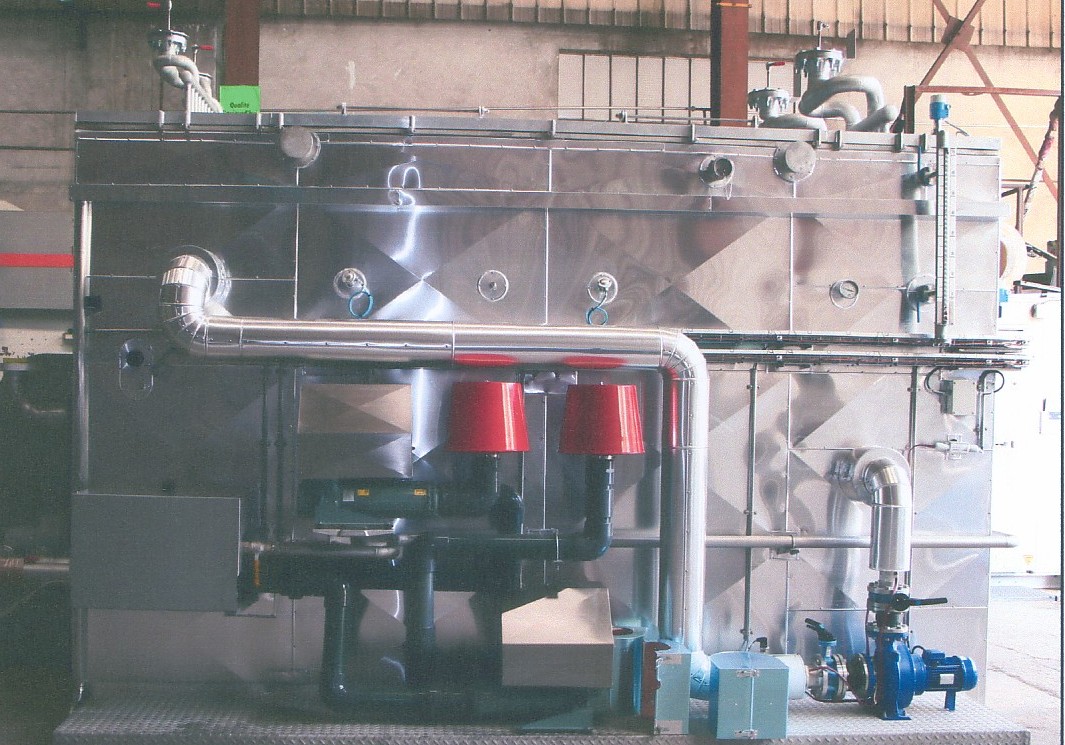
- Argon Vaporizer 2*6 350 Nm³/h Double T.I.C Nappe Diaphragm®
Atmospheric heaters
These high or low pressure heaters draw from the ambient atmosphere, the energy necessary for the vaporization of cryogenic liquids. They are therefore characterized by their external exchange surface which is particularly important.
On the other hand, their vaporization rate varies according to the atmospheric conditions and the continuous operating time. As an indication, the variation in the case of continuous operation can be reduced by 50% over a period of 12 hours. Between an ambient temperature of -10 °C and + 25 °C the flow will vary from ~ 50%.
This explains why this type of device is reserved for discontinuous needs.
Cryoptim®
For the OPTIMization of your CRYOgenic systems
Energy is more and more expensive. In terms of gas vaporization, the annual energy operating cost is a multiple of the cost of purchasing the vaporizer itself.
The interest of having a cryogenic installation optimized from an energy point of view has an undeniable economic interest.
With CRYOPTIM®, be sure to have a CRYOgenic OPTIMum installation for your operation.
Successfully completed projects
Need a professionnal advice ?
For additional information, a quote or a quick intervention